Precast concrete or GRC

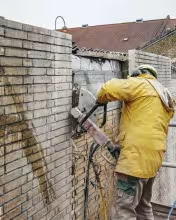
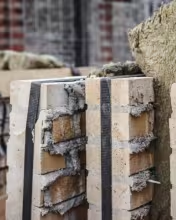
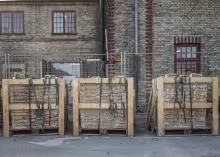
Cutting buildings into panels (179)
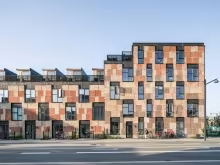
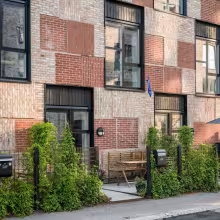
Recycling is a must. When recycling old brick walls, we tend to think that the recyclable element is the brick; we need to separate it from the rest of the elements and clean the mortar. It is cleverer to understand that a wall is much more than a brick, and thus, we can recycle it as panels! We reuse the small element, that is, the brick, and we benefit from the work of the craftsman of the time when the original building was erected. 

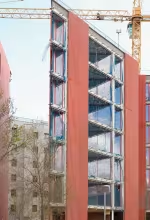
A contradiction that works (178)

A light highly-prefabricated panel over a heavy handmade wall, a contradiction that works.
A heavy concrete panel will imply having mass on the outside of the thermal insulation, as those solutions are commonly insulated from the inside. If the objective is having this thermal inertia in the inner side of the insulation, the solution is good: a heavy interior wall insulated over its outer face and a low-weight panel so as not to overload the façade where it is not necessary.

Stone prefabricated cladding (117)

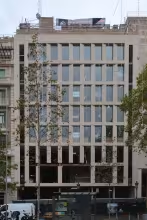
Prefabricated concrete panels that incorporate stone cladding are not something new. One example is the Hotel in Plaza España, designed by the architect Enric Garces, and built in 1990. However, we want to draw attention to the appropriateness of the solution today.

As we mentioned in the wake of the SBG Schönburg building in Bern, open-joint cladding is in crisis, not because of its performance, which nobody questions, but merely for formal reasons.

Concrete panels inner layer (103)

This rain screen façade clearly demonstrates evolution along the path to prefabrication. Both the interior and exterior layers are built with highly prefabricated dry systems and it is not so common to find such a massive solution. This enables the façade to loose neither its thermal inertia nor reduce the acoustic barrier.

The inner layer, which uses heavy concrete panels, is a very good option.

Thermal behaviour of the palm trees facade (048)

The façade of the Renaissance hotel in L’Hospitalet has a peculiar thermal behaviour. It is based on retarding thermal loss with the concrete wall (thermal inertia), while minimizing the thermal difference between the two sides of this wall with a closed air cavity on its outer side. This closed air cavity has its thermal insulation improved by a reflective membrane coating one of its sides.

Subscribe to Precast concrete or GRC